
Creativity is often treated like a special talent that belongs to artists, writers, or musicians. In reality, creativity is a skill everyone can practice. It appears whenever you find a new way to solve a problem, explain an idea, arrange a room, prepare a meal, or enjoy your surroundings.
You do not need expensive tools, long blocks of free time, or perfect ideas to become more creative. Small, regular activities can help you notice possibilities, build confidence, and make everyday routines more enjoyable. The key is to focus on curiosity rather than results.
Start With Small Creative Sessions
A creative practice does not have to take an hour. Begin with five or ten minutes a day. A short session is easier to fit into a busy schedule and can help you build consistency.
Choose a regular time, such as:
– While drinking your morning coffee
– During a lunch break
– After finishing work
– Before going to bed
– While waiting for an appointment
Keep your materials simple. Use a notebook, a phone, a basic drawing tool, or anything else that feels convenient. The goal is to make creativity easy to begin, not to create a complicated routine.
Keep a Daily Idea List
Ideas can come from ordinary moments. Keep a running list of interesting observations, questions, phrases, images, or problems you notice during the day.
You might write down:
– A color combination you saw outside
– An unusual word or name
– A question you have always wondered about
– A funny conversation
– A better way to organize a task
– A story suggested by something you noticed
Do not judge the ideas as you record them. Some may seem unimportant at first, but they can become useful later. A daily idea list also trains you to pay closer attention to the world around you.
Try Quick Writing Prompts
Writing is one of the simplest ways to exercise your imagination. You do not need to write a complete story or polished essay. Set a timer for five minutes and respond to a prompt without stopping to edit.
Try prompts such as:
– Describe a familiar place as if you have never seen it before.
– Write about an object that could tell its own story.
– Begin with the sentence, “Everything changed when the door opened.”
– Explain a daily routine from another person’s point of view.
– Create a conversation between two things that are usually ignored.
If you get stuck, describe what you can see, hear, smell, or touch. Sensory details often provide a natural starting point.
Make Everyday Sketches
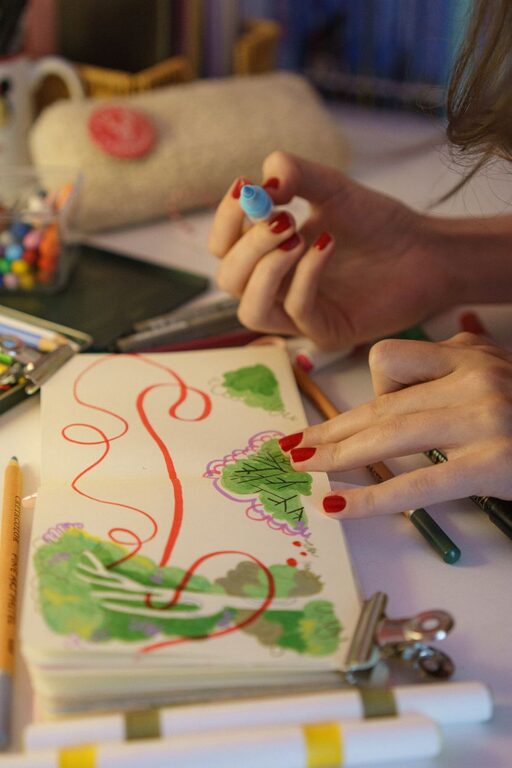
Drawing is useful even if you do not consider yourself an artist. The purpose is not to create a perfect picture. Sketching encourages observation and helps you notice shape, proportion, texture, and space.
Choose one simple subject each day:
– A cup or other household object
– A plant
– Your shoes
– A building nearby
– Your hand
– A view from a window
Use quick lines and avoid erasing too much. You can also experiment with patterns, shapes, or abstract marks. The more relaxed the process feels, the easier it becomes to continue.
Change Your Drawing Rules
Creative limits can make drawing more interesting. Try using your opposite hand, drawing without lifting your pencil, or completing a sketch in one minute. Restrictions remove some pressure and encourage you to make unexpected choices.
Add Variety to Familiar Routines
Routine can save time, but doing everything the same way may reduce your awareness. Change one small part of a familiar activity and notice what happens.
For example, you could:
– Take a different route on a walk
– Rearrange items on a shelf
– Prepare a familiar meal with different ingredients
– Listen to a new type of music
– Read a magazine or book outside your usual interests
– Use a new layout for your notes
These changes do not have to be dramatic. Small variations expose you to new combinations, which can lead to fresh ideas.
Practice Creative Problem-Solving
Many daily challenges are opportunities to think creatively. When you face a problem, avoid accepting the first solution immediately. Give yourself a few minutes to list several possibilities, including unusual ones.
Use questions like:
– What is another way to approach this?
– What would make the task easier?
– Can I remove a step?
– Could I combine two solutions?
– What would I try if I had fewer resources?
– What would a beginner notice?
You do not need to use every idea. The exercise is valuable because it helps you move beyond automatic responses.
Use Creative Constraints
Having too many choices can make it difficult to begin. Limits can provide direction and make a project feel manageable.
Set a simple rule, such as:
– Write no more than 100 words
– Use only three colors
– Take five photographs of the same subject
– Create something from materials you already have
– Finish a small project in 20 minutes
– Use one object in three different ways
Constraints encourage resourcefulness. They also make it easier to measure progress without comparing your work to someone else’s.
Find Inspiration Without Copying
Inspiration can come from books, music, nature, architecture, conversations, and other forms of creative work. Spend a few minutes each day exploring something unfamiliar.
When you find something interesting, ask:
– What do I like about it?
– How was it made?
– What feeling does it create?
– What technique could I adapt?
– How could I interpret the idea in my own way?
The goal is not to copy another person’s work. Instead, study what catches your attention and use it as a starting point for your own experiments.
Make Room for Play
Play is a valuable part of creativity because it removes the expectation of being productive. Try an activity simply because it is enjoyable or curious.
You might build something with blocks, arrange objects by color, make up a word, create a paper collage, or experiment with a new recipe. Give yourself permission to make something that has no practical purpose.
When play is part of your routine, creativity becomes less intimidating. You learn that an activity can be worthwhile even when the result is imperfect or unfinished.
Reflect on Your Progress
At the end of each week, spend a few minutes reviewing what you made or noticed. Ask yourself:
– Which activity felt most enjoyable?
– When did ideas come most easily?
– What made it difficult to begin?
– What would I like to try next?
– Did any small idea develop into something larger?
Keep the reflection simple. Creativity grows through repeated practice, and progress may appear as greater curiosity, confidence, or willingness to experiment rather than as a finished project.
Make Creativity a Regular Habit
The most effective creative routine is one you can maintain. Choose one or two activities that fit naturally into your life, then build from there. You might write for five minutes each morning, sketch during a break, or collect ideas before bed.
Do not wait for perfect conditions or a sudden burst of inspiration. Start with a small action, stay curious, and allow yourself to experiment. With regular practice, creativity can become a natural part of everyday life rather than something reserved for special occasions.